The Expensive Mistake: Building Before Validating
⠀
Many founders spend real money proving that nobody wanted their idea.
⠀
They start at the end.
⠀
They think about the product, the capital, the branding, the website, the developer, the supplier.
⠀
They ask:
⠀
How do I build this?
⠀
But they forget to ask:
⠀
Who actually needs this badly enough to pay for it?
⠀
A business idea can sound logical, solve an apparent problem, and fill an obvious gap while still failing to create a viable business.
⠀
This is why market validation should come before serious investment. Market research helps turn assumptions about customers, competitors, and demand into information that can actually guide a founder's decisions. MuslimBiz
⠀
The wrong sequence is:
⠀
Idea → Product → Branding → Website → Launch → Customers
⠀
A safer sequence is:
⠀
Problem → Customer → Validation → Product → Launch
⠀
Muslim founders should be particularly conscious of this. The money, time, skills, and opportunities Allah has given us are resources we are responsible for using carefully.
⠀
The goal is not to eliminate risk. Business will always involve risk.
⠀
The goal is to avoid spending thousands of dollars answering a question that could have been answered for $100.
⠀
⠀
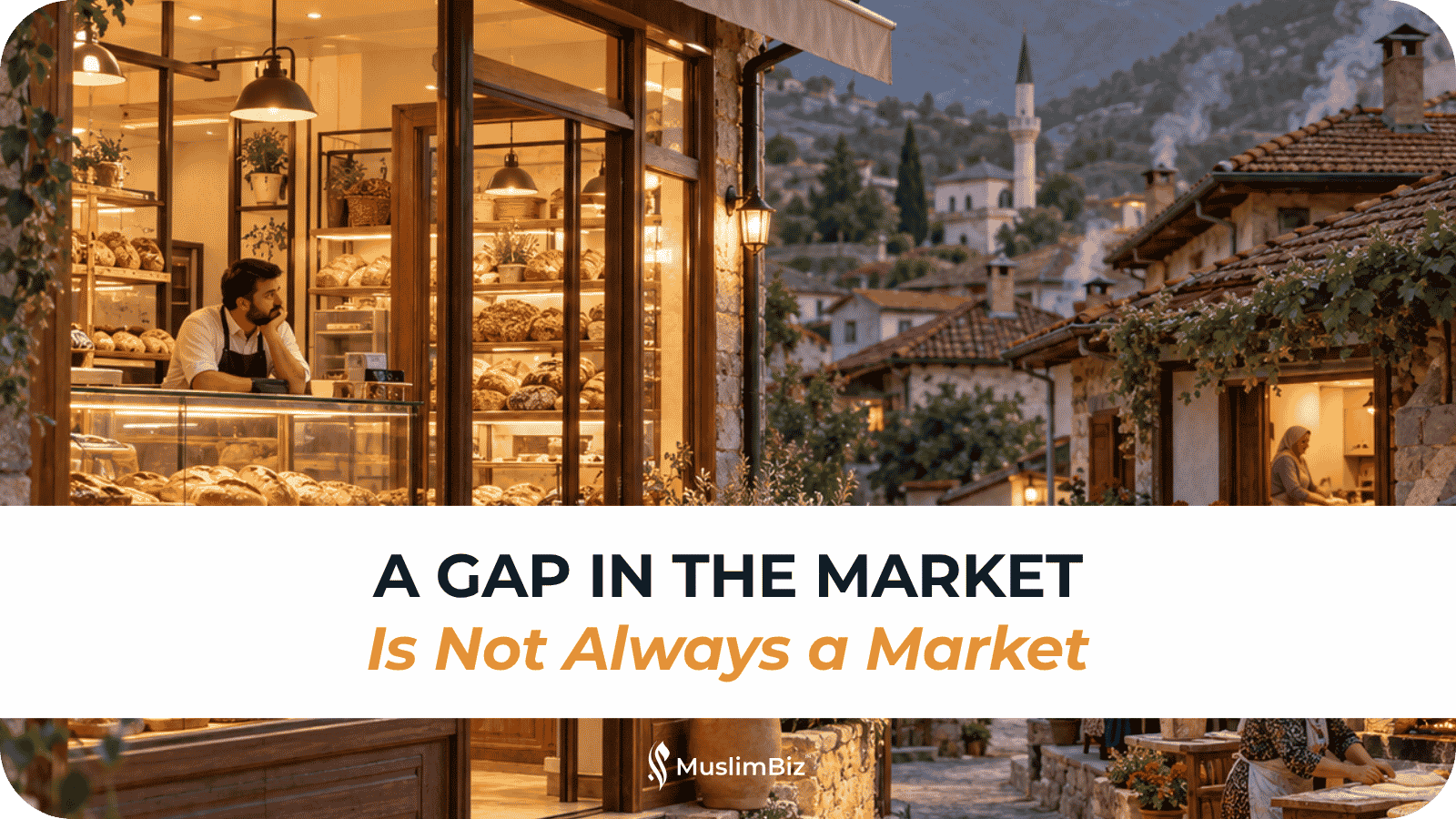
The Bakery With No Customers
⠀
Imagine a village with no bakery.
⠀
A founder gets excited.
⠀
First bakery in town. No competition. Everyone eats bread. It looks like a clear opportunity.
⠀
So he rents a location, buys ovens, orders equipment, renovates the shop, creates the branding, and opens the doors.
⠀
Then almost nobody comes.
⠀
Why?
⠀
Because the villagers have been making bread at home for generations.
⠀
They enjoy making it. They prefer the taste. It is inexpensive. Most importantly, they do not feel enough pain with their existing solution to change their behavior.
⠀
The founder correctly identified a gap in supply.
⠀
But he incorrectly assumed there was unmet demand.
⠀
That distinction can determine whether a founder makes or loses thousands of dollars.
⠀
No competitor does not automatically mean no competition.
⠀
The bakery was competing against homemade bread.
⠀
An app might compete against spreadsheets.
⠀
A software platform might compete against WhatsApp.
⠀
A paid service might compete against customers simply doing the work themselves.
⠀
This is why, when coming up with a business idea, identifying a problem or gap should only be the beginning. You still need to determine whether people actually want a different solution. MuslimBiz
⠀
One of the most important questions you can ask is:
⠀
How are people solving this problem today?
⠀
If customers already spend significant time or money using an inconvenient alternative, that can be valuable evidence that the underlying problem matters.
⠀
This is the idea behind customer discovery: founders test their assumptions about the customer and business model instead of treating those assumptions as facts. Steve Blank
⠀
Sometimes there is no competition because nobody has discovered the opportunity yet.
⠀
But sometimes there is no competition because there is no worthwhile market.
Muslim Founder Brief
A daily briefing on Muslim ownership, responsibility, and disciplined building.
What Actually Proves That a Market Exists?
⠀
Not all validation is equal.
⠀
Imagine asking twenty villagers:
⠀
“Would you buy fresh bread if somebody opened a bakery here?”
⠀
Fifteen say yes.
⠀
That sounds encouraging.
⠀
But then the bakery opens and only two actually buy.
⠀
What happened?
⠀
People's stated intentions and their actual behavior are not always the same.
⠀
This is why founders should distinguish between interest and evidence.
⠀
Weak Evidence
⠀
Someone tells you:
⠀
“That's a great idea.”
⠀
“I would definitely use that.”
⠀
“You should build this.”
⠀
Likes, comments, survey responses, and compliments can provide useful information.
⠀
But they are not purchases.
⠀
Better Evidence
⠀
Potential customers repeatedly describe the problem without you prompting them.
⠀
They complain about their current solution.
⠀
They already spend time or money trying to solve the problem.
⠀
They join a targeted waiting list.
⠀
They ask when your solution will become available.
⠀
Stronger Evidence
⠀
Customers place a pre-order.
⠀
They pay a deposit.
⠀
They purchase a prototype.
⠀
They pay for a pilot.
⠀
They use an imperfect MVP.
⠀
They return and purchase again.
⠀
They recommend the solution to other people.
⠀
The closer your test gets to actual customer behavior, the stronger the evidence becomes.
⠀
This is why testing your idea before you launch matters. Small prototypes, real feedback, trials, and measurable results can reveal whether demand exists before you commit substantially more resources. MuslimBiz
⠀
A useful principle for founders is:
⠀
Behavior is stronger evidence than opinions. Payment is stronger evidence than interest.
⠀
⠀
Sell Bread From a Cart First
⠀
Now imagine that our bakery founder approached the opportunity differently.
⠀
Instead of immediately renting a building and buying expensive equipment, he baked a small quantity of bread and spent 30 days selling it from a cart in the village.
⠀
His investment would be tiny compared with opening a bakery.
⠀
But he would begin learning immediately.
⠀
Which families buy?
⠀
How often do they buy?
⠀
What type of bread do they prefer?
⠀
What price will they pay?
⠀
Do they come back?
⠀
Do they tell their neighbors?
⠀
Does demand increase, remain stable, or disappear after the novelty wears off?
⠀
After 30 days, he may discover that there is enough demand to justify opening the bakery.
⠀
Or he may discover that nobody wants it.
⠀
Both outcomes are valuable.
⠀
One gives him evidence to invest.
⠀
The other saves him thousands.
⠀
Find Your Version of the Bread Cart
⠀
If you want to open a restaurant, start with catering, delivery, or a pop-up.
⠀
If you want to manufacture a product, build ten prototypes before ordering 1,000 units.
⠀
If you want to create a course, run a paid workshop before recording 50 lessons.
⠀
If you want to build software, manually deliver part of the service before spending months developing automation.
⠀
If you want to open a physical location, test demand through temporary events.
⠀
If you want to build a marketplace, manually connect buyers and sellers first.
⠀
Your first version does not need all the infrastructure of the final business. Sometimes the better question is simply: what is the smallest version someone will pay for?MuslimBiz
⠀
That first version might be ugly.
⠀
It might be manual.
⠀
It might involve processes that could never support 10,000 customers.
⠀
That is okay.
⠀
At this stage, you are trying to learn—not scale.
⠀
This is closely related to the startup principle of building something people want before scaling the team or product. Hacker News
⠀
Your first version exists to prove that the next version deserves to exist.
⠀
A few conversations and 30 days selling bread from a cart can save you thousands at the end.
⠀
Validation is cheaper than disappointment.
⠀
⠀
Problem → Customer → Proof → Product
⠀
Founders do not go broke only because they build badly.
⠀
Many go broke because they build too early.
⠀
A beautiful website cannot manufacture demand.
⠀
Great branding cannot create a painful problem.
⠀
Investment cannot turn indifference into product-market fit.
⠀
More features cannot rescue a product whose fundamental assumption was wrong.
⠀
Before committing serious resources, move through four stages.
⠀
Problem
⠀
What specific problem are you solving?
⠀
How painful is it?
⠀
How frequently does it occur?
⠀
How are people dealing with it today?
⠀
Customer
⠀
Who experiences this problem strongly enough to want something better?
⠀
Be specific.
⠀
“Muslims” is not a customer segment.
⠀
Neither is “small businesses” or “parents.”
⠀
A Muslim meal-prep company, for example, might be targeting busy Muslim professionals in a particular city who want convenient halal meals during the working week.
⠀
The more specific the customer becomes, the easier it becomes to understand the problem, test the offer, and interpret the results.
⠀
Proof
⠀
What would customers have to do for you to believe the demand is real?
⠀
Sign up?
⠀
Book a consultation?
⠀
Place a deposit?
⠀
Pre-order?
⠀
Pay?
⠀
Use the product repeatedly?
⠀
Define the evidence before running the experiment.
⠀
Otherwise, excitement can cause founders to reinterpret weak results as success.
⠀
Product
⠀
Only then should you begin committing increasingly serious resources to building the solution.
⠀
Even then, build gradually.
⠀
Test.
⠀
Learn.
⠀
Improve.
⠀
Repeat.
⠀
The more expensive your next decision becomes, the stronger the evidence you should demand before making it.
⠀
Capital should help accelerate something for which there is evidence.
⠀
It should not simply make an untested assumption more expensive.
⠀
Validation Is Cheaper Than Disappointment
⠀
A founder's job is not to prove that his original idea was brilliant.
⠀
His job is to discover the truth.
⠀
Sometimes validation tells you to continue.
⠀
Sometimes it tells you to change the product.
⠀
Sometimes it reveals a different customer.
⠀
And sometimes it tells you to abandon the idea entirely.
⠀
That is not necessarily failure.
⠀
Discovering that nobody wants your product before spending $50,000 building it may be one of the most profitable discoveries you ever make.
⠀
So before asking:
⠀
“How do I build this?”
⠀
Ask:
⠀
“What evidence would convince me that this should be built at all?”
⠀
Start with the problem.
⠀
Then the customer.
⠀
Then the proof.
⠀
Then the product.
Muslim Founder Academy
Everything you need to build your business the Muslim way - from idea to institution.