
The 2 Business Metrics Every New Muslim Founder Should Track
⠀
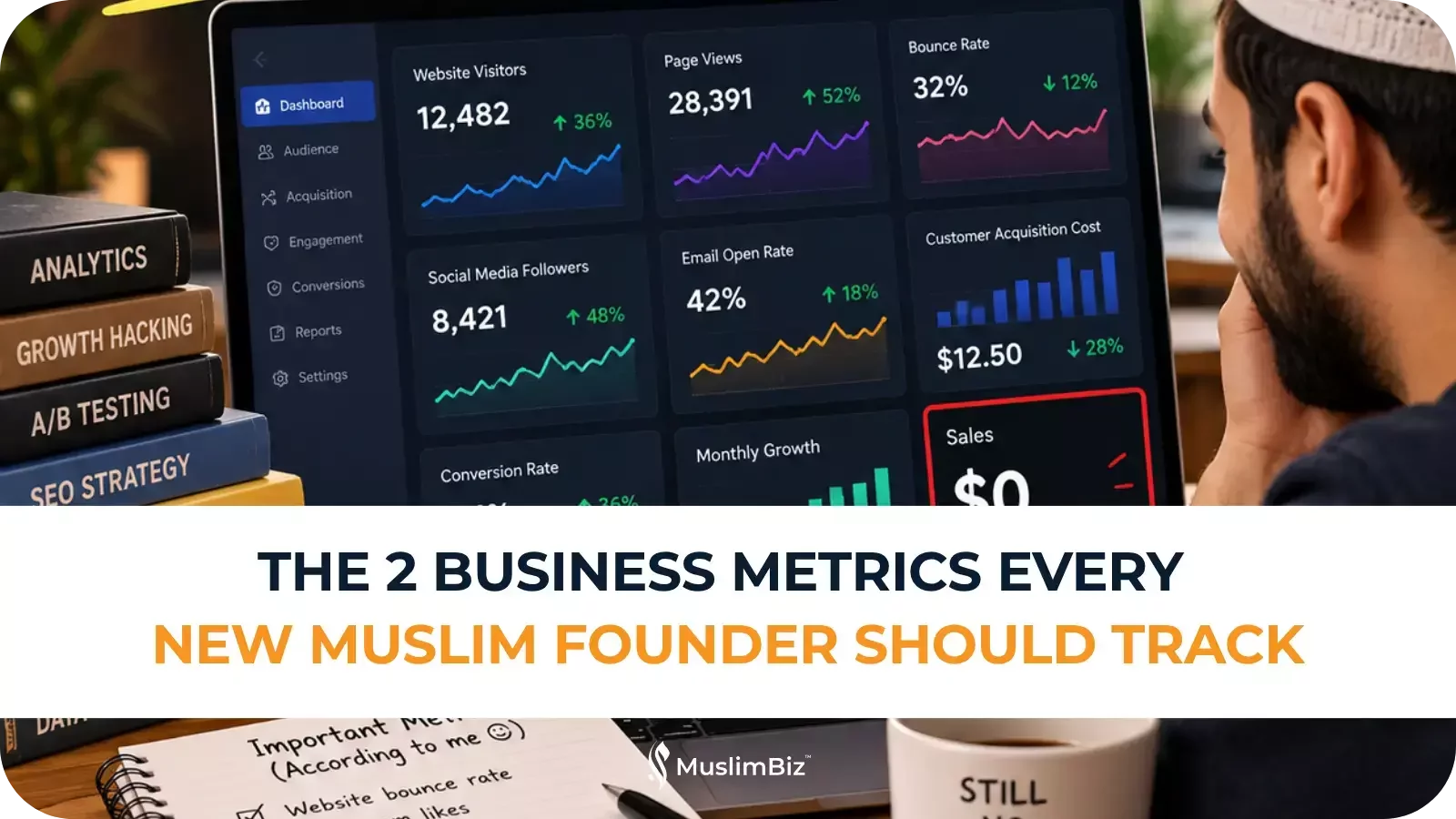
Some founders have 27 business metrics, 14 dashboards, and exactly ZERO customers.
⠀
Welcome to modern entrepreneurship.
⠀
Before making their first sale, some entrepreneurs are already tracking website traffic, social media engagement, customer acquisition costs, email open rates, and monthly growth projections.
⠀
Some even have beautiful charts showing how their business is growing.
⠀
The only problem?
⠀
The business hasn't made a single dollar.
⠀
There is nothing wrong with tracking business performance. Understanding your numbers becomes increasingly important as your company grows.
⠀
But for a new Muslim entrepreneur, particularly during the first 30 days of business, the priority should be much simpler.
⠀
You need to sell something.
⠀
Why New Entrepreneurs Track Too Many Business Metrics
⠀
Modern entrepreneurs have access to more business analytics tools than ever before.
⠀
You can measure how many people visit your website, how long they stay, where they come from, and whether they click a particular button.
⠀
You can track social media impressions, engagement rates, email subscribers, and dozens of other performance indicators.
⠀
These numbers can provide valuable insights.
⠀
But they can also create the illusion of progress.
⠀
A founder might spend hours analyzing website traffic while avoiding the uncomfortable task of speaking directly with potential customers.
⠀
Another might celebrate gaining 1,000 social media followers without asking whether any of those followers are willing to purchase the product.
⠀
Being busy measuring your business is not the same as building your business.
⠀
For Muslim founders working with limited capital and resources, this distinction is especially important.
⠀
Every hour spent analyzing unnecessary metrics is an hour that could have been spent developing a product, speaking with customers, or generating revenue.
⠀
Business Metric #1: Actual Sales and Revenue
⠀
During the early stages of a business, one number deserves more attention than almost anything else.
⠀
How much money have customers actually paid you?
⠀
Not how many people liked your business idea.
⠀
Not how many promised to purchase something next month.
⠀
Not how many people visited your website.
⠀
Actual sales.
⠀
Money collected from real customers.
⠀
This matters because a paying customer provides something that compliments, likes, and social media engagement cannot.
⠀
Evidence that someone values your product enough to spend their money on it.
⠀
You might believe your business idea is excellent.
⠀
Your friends might agree.
⠀
Your social media audience might even encourage you to pursue it.
⠀
But until someone purchases your product or service, you have not demonstrated that customers are willing to pay for what you offer.
⠀
This is why early-stage entrepreneurs should prioritize validating customer demand before investing heavily in complicated systems.
⠀
As explained in Y Combinator's Startup Advice, successful early-stage founders benefit from focusing on building something customers want rather than becoming distracted by activities that do not move the business forward.
⠀
For Muslim entrepreneurs, the objective should not simply be to launch another company.
⠀
It should be to establish a genuine business that provides value, generates halal income, and has the potential to become financially sustainable.
⠀
Business Metric #2: Profit, Not Just Revenue
⠀
Immediately after understanding your sales comes another essential number.
⠀
Profit.
⠀
Because generating $1,000 in revenue while spending $1,500 to achieve it is not exactly a business model worth celebrating.
⠀
Revenue tells you how much money your business brings in.
⠀
Profit tells you how much remains after accounting for expenses.
⠀
A company can generate impressive sales figures and still lose money.
⠀
For example, imagine a new Muslim entrepreneur selling products online.
⠀
During the first month, the business generates $5,000 in sales.
⠀
That sounds promising.
⠀
But the founder spends $2,500 purchasing inventory, $1,000 on advertising, $700 on shipping, and $500 on other operating expenses.
⠀
After accounting for those costs, only $300 remains.
⠀
The business generated $5,000 in revenue but only $300 in profit before any additional applicable expenses or taxes.
⠀
Revenue can make a business look successful. Profit helps determine whether it is financially sustainable.
⠀
This does not mean every new business must immediately become profitable.
⠀
Some businesses require substantial investment before reaching profitability.
⠀
But founders must understand how much they are earning, how much they are spending, and whether their current business model can eventually support itself.
⠀
Without that understanding, growing sales can sometimes mean growing losses.
Muslim Founder Brief
A daily briefing on Muslim ownership, responsibility, and disciplined building.
How to Track Your Startup's Sales and Profit Without Expensive Software
⠀
You do not need expensive accounting software, complicated financial models, or a weekend studying business analytics to understand your company's early financial performance.
⠀
A simple spreadsheet can be enough to get started.
⠀
Record how much customers pay you.
⠀
Record how much you spend.
⠀
Calculate what remains.
⠀
For example:
⠀
Monthly Revenue: $3,000
⠀
Monthly Expenses: $2,200
⠀
Monthly Profit: $800
⠀
Of course, your financial records should distinguish between revenue, cash collected, expenses, and profit where necessary.
⠀
You should also maintain proper accounting records and fulfill your tax, legal, and financial obligations.
⠀
As your business grows, additional metrics such as customer acquisition cost, cash flow, customer retention, and profit margins become increasingly valuable.
⠀
The U.S. Small Business Administration's financial management resources provide useful guidance on bookkeeping, financial statements, and managing business finances.
⠀
But in the earliest stages, avoid making your business more complicated than necessary.
⠀
Start by understanding whether customers are paying you and whether your business can make money serving them.
⠀
Muslim Founders Should Focus on Building Profitable, Sustainable Businesses
⠀
Our Ummah needs more Muslims building profitable, sustainable businesses.
⠀
Businesses that create employment.
⠀
Businesses that provide useful products and services.
⠀
Businesses that strengthen Muslim ownership and economic independence.
⠀
Businesses that operate according to Islamic principles.
⠀
But none of this happens simply because a founder has mastered business analytics.
⠀
It happens when entrepreneurs develop valuable products, attract paying customers, manage their expenses, and build companies capable of surviving beyond their initial excitement.
⠀
Islam encourages honesty, responsibility, and fairness in our financial dealings.
⠀
Allah سبحانه وتعالى says:
⠀
"And do not consume one another's wealth unjustly..." (Qur'an 2:188)
⠀
For Muslim founders, financial responsibility should be part of building a business upon sound principles.
⠀
This means understanding where money comes from, how it is spent, and whether the business can fulfill its obligations to customers, employees, suppliers, and others.
⠀
A profitable business is not automatically a halal business, and profitability alone does not determine success in Islam.
⠀
But building a financially sustainable company through permissible means can help Muslim entrepreneurs support their families, create opportunities for others, and contribute to the wider Muslim economy.
⠀
Don't confuse tracking your business with building your business.
⠀
Your first priority is not to become an expert at measuring a company that barely exists.
⠀
Your first priority is to create something valuable enough that customers are willing to pay for it.
⠀
Then understand what it costs to deliver that value.
⠀
Build from there.
⠀
Our Ummah needs more profitable Muslim-owned businesses, not more founders becoming experts at measuring businesses that don't exist yet.
⠀
What unnecessary business metrics do you see new entrepreneurs spending too much time on?
Build Your Business With Clarity and Purpose
Building a business is difficult. You don't have to figure everything out alone.
Get practical, one-on-one guidance to overcome challenges, make better decisions, and build a sustainable business aligned with your Islamic values.