
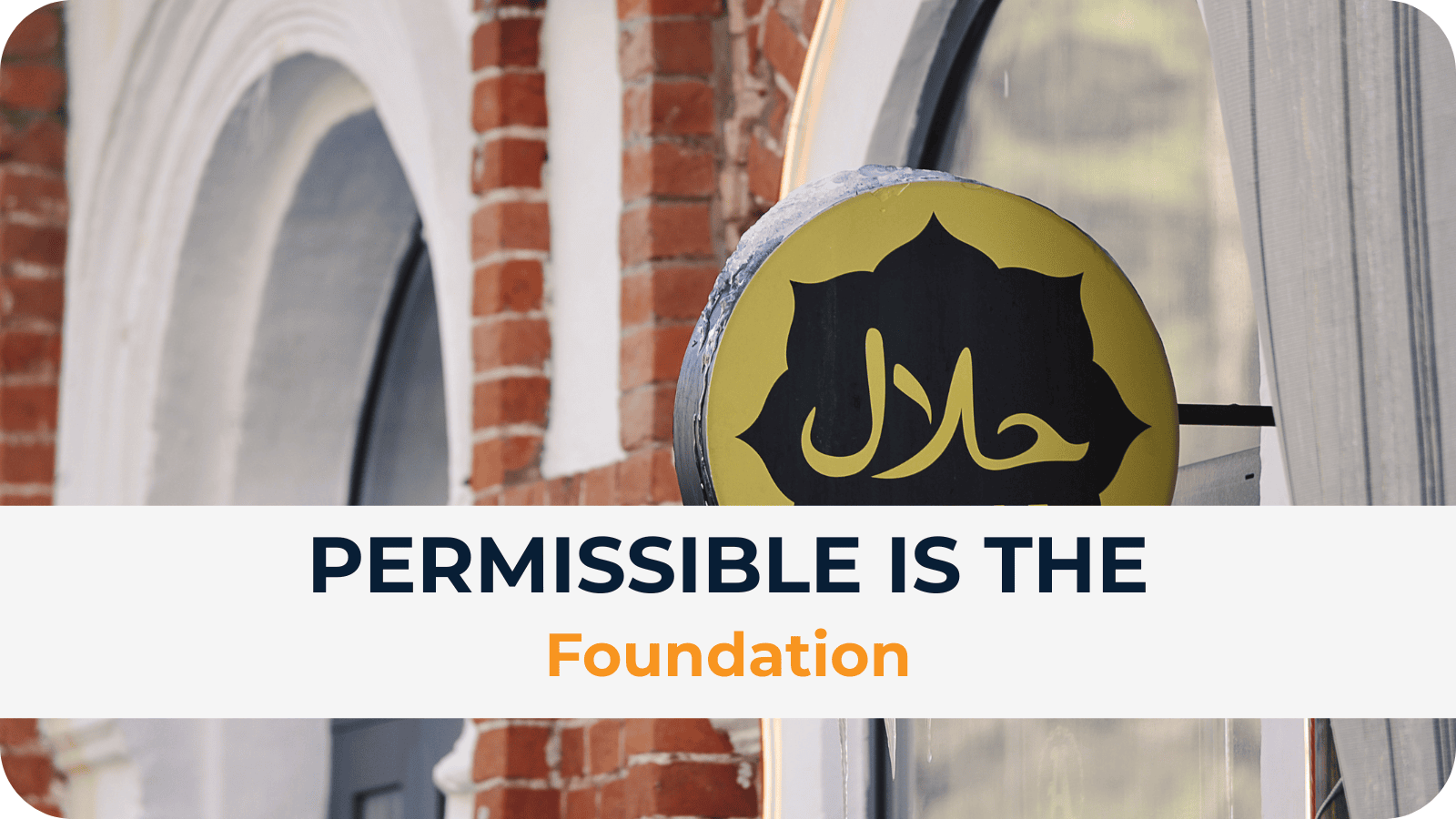
Every durable structure begins with a foundation that can support its weight. When the foundation is compromised, no amount of external polish can compensate for the instability beneath it.
The same principle applies to business.
Before strategy, branding, or growth, there is a more fundamental decision every founder makes: What will I offer? The answer to this question quietly determines the direction, reputation, and resilience of the entire enterprise.
Many entrepreneurs evaluate opportunities primarily through the lens of profitability. If demand exists and margins appear attractive, the offering is often considered viable.
Yet for Muslim founders, viability is not measured by revenue potential alone.
Permissibility is not a secondary consideration. It is the ground upon which everything else stands.
Allah (سبحانه وتعالى) says:
“O mankind! Eat of that which is lawful and good on the earth, and follow not the footsteps of Shaitan. Verily, he is to you an open enemy.” (Qur’an 2:168)
Notice that the command joins two qualities: lawful and good. This pairing directs believers toward offerings that are not merely technically permissible but also beneficial.
When permissible becomes the foundation, business gains clarity. And clarity is one of the greatest sources of long-term strength.
Foundations Quietly Shape Outcomes
What a business sells is not a neutral choice. It influences the type of customers attracted, the partnerships formed, and the reputation that develops over time.
Founders sometimes focus heavily on operational excellence while overlooking the deeper implications of their offering. But operational strength cannot fully stabilize a business built on questionable ground.
A clear foundation simplifies leadership.
When the boundaries are defined early, many difficult decisions never arise. The founder is not forced into constant internal negotiation between conviction and opportunity.
Strong structures are rarely the result of constant correction. They are the result of principled beginnings.
Choosing permissible offerings establishes a framework within which the business can expand confidently rather than cautiously.
Profit Alone Is an Incomplete Compass
Profit is essential for sustainability. No responsible business ignores financial reality. However, profitability by itself does not determine whether something is worth building.
Markets frequently reward what is convenient, trending, or emotionally persuasive. But what is rewarded in the short term is not always what proves stable over decades.
A founder guided exclusively by profit becomes reactive, continually adjusting to wherever margins appear strongest. This creates strategic drift.
Permissibility, by contrast, provides orientation.
It answers an important leadership question before it is even asked:
“Is this a path I am willing to scale?”
Without such orientation, growth can lead a business into areas that complicate its identity and dilute its credibility.
Clarity at the foundation protects against that drift.
Muslim Founder Brief
A daily briefing on Muslim ownership, responsibility, and disciplined building.
Ownership Changes Financial Direction
There is a structural shift that occurs when a person moves from earning alone to owning productive resources.
Ownership transforms financial movement into financial architecture.
Instead of relying solely on effort, you begin relying on systems that continue generating value. This reduces fragility and introduces continuity.
Importantly, ownership is not about speed. It is about intention.
Small, consistent steps toward acquiring productive holdings often prove more durable than aggressive but poorly considered moves. Builders understand that permanence is rarely rushed.
They prioritize sound structure over rapid expansion.
Financial direction changes the moment earning is paired with deliberate building.
Reputation Begins With the Offering
Reputation is often discussed in terms of service quality or customer experience, yet its roots extend deeper.
The market remembers what you associate with.
Over time, your offerings become shorthand for your standards. Customers may not analyze your internal processes, but they quickly understand what your business represents.
When a company consistently provides what is permissible and beneficial, it reduces uncertainty. Customers approach with greater ease because fewer questions need to be asked.
Trust grows fastest where doubt is minimal.
This trust carries strategic value. It lowers resistance, encourages retention, and strengthens word-of-mouth. While marketing can generate attention, credibility sustains it.
For founders seeking durability rather than temporary visibility, reputation is among the most valuable assets they will ever build.
And reputation begins with what is placed into the market.
Clear Boundaries Strengthen Leadership
Decision fatigue is a quiet burden in entrepreneurship. The more ambiguous the operating environment, the more energy leadership must expend evaluating each new possibility.
Clear boundaries remove this friction.
When permissibility is established as non-negotiable, opportunities that fall outside those lines are declined quickly, without prolonged internal conflict. This preserves both focus and momentum.
Contrary to common fear, constraints do not weaken businesses. They often refine them.
Boundaries force sharper thinking. They encourage innovation within principled limits and attract stakeholders who respect consistency.
A business that stands for something unmistakable is easier to understand and easier to trust.
Clarity is efficient. Ambiguity is expensive.
Trust Compounds More Reliably Than Opportunistic Gains
Short-term opportunities can be attractive, particularly when they promise rapid financial improvement. Yet opportunistic decisions often carry hidden costs.
Each questionable offering introduces a degree of uncertainty into the relationship between the business and its customers.
Repeated over time, this uncertainty erodes confidence.
Trust, on the other hand, compounds quietly. It rarely produces dramatic spikes, but it builds a stable base from which growth becomes more predictable.
Customers return where they feel secure. Partners collaborate where standards are evident. Communities support what aligns with their values.
The Prophet Muhammad (صلى الله عليه وسلم) said:
“The truthful and trustworthy merchant will be with the Prophets, the truthful, and the martyrs.”
(Jami‘ at-Tirmidhi, Hadith 1209)
Trustworthiness is not limited to speech or contracts. It is reflected in what a business chooses to place before people.
Offerings are declarations of standard.
Permissibility Invites Barakah
Barakah is often spoken about, yet sometimes misunderstood. It is not merely increase in quantity but presence of goodness, continuity, and benefit within what already exists.
While outcomes always remain in the control of Allah (سبحانه وتعالى), founders are responsible for the ground upon which they build.
Choosing permissible products does not guarantee ease, nor does it eliminate market challenges. But it aligns effort with a path that invites goodness rather than internal contradiction.
There is a profound difference between scaling something you are fully at peace with and scaling something you feel compelled to justify.
One creates steadiness. The other creates tension.
When the source is clean, growth rests on firmer ground.
A Business You Never Have to Defend
One of the quiet advantages of principled entrepreneurship is psychological clarity.
Founders carry enough pressure navigating competition, uncertainty, and operational complexity. Adding moral discomfort to that load is unnecessary.
Building a business you never have to defend creates a different leadership posture. Decisions are made with greater composure. Communication becomes more confident. Vision extends further because it is not constrained by hidden hesitation.
Customers sense this confidence even if it is never explicitly discussed.
Over time, the business becomes known not only for what it provides, but for the standards it refuses to compromise.
This is how identity is formed.
And identity, once established, becomes difficult for competitors to replicate.
Conclusion
Every founder begins with a choice that shapes everything that follows: what to bring into the marketplace.
Strategy can evolve. Products can improve. Operations can mature. But the foundation remains.
Permissibility is not a limitation placed upon ambition. It is a structure that supports ambition with integrity and clarity.
For Muslim founders, this orientation reflects awareness that business is not separate from accountability before Allah (سبحانه وتعالى). What is offered carries weight because it touches the lives of others.
Strong businesses do not treat permissibility as an afterthought. They build upon it from the very beginning.
Choose offerings that align with conviction. Establish boundaries that simplify leadership. Build trust that compounds over time.
When the foundation is sound, growth is not merely possible. It is sustainable.
Permissible is the foundation. Everything durable rises from there.
Muslim Founder Academy
Everything you need to build your business the Muslim way - from idea to institution.