
When Business Meetings Take Priority Over Salah
⠀
A Muslim professional will reschedule a meeting for a client, a dentist, or lunch.
⠀
But when the adhan comes, suddenly the calendar becomes sacred.
⠀
"The meeting is running over."
⠀
"Just five more minutes."
⠀
"I'll pray when we're done."
⠀
Sometimes Salah is delayed.
⠀
Sometimes it is missed altogether.
⠀
And what makes this particularly concerning is that some of these workplaces are Muslim-owned.
⠀
They sell halal products, avoid riba, and speak about serving the Ummah.
⠀
Yet their operating schedules treat Salah as an inconvenience rather than an obligation.
⠀
We have copied the modern workplace so closely that even our Muslim companies expect worship to fit around business.
⠀
But Islam does not work that way.
⠀
When the Workplace Calendar Becomes More Important Than Prayer
⠀
Most companies organize their schedules around commercial priorities.
⠀
Meetings are arranged according to client availability.
⠀
Lunch breaks are protected.
⠀
Appointments are scheduled weeks in advance.
⠀
And employees are expected to respect these commitments.
⠀
But when Salah enters the equation, the same discipline often disappears.
⠀
Prayer becomes something employees must squeeze between meetings, customer calls, and deadlines.
⠀
Sometimes employees are technically permitted to pray, but the workplace culture makes them uncomfortable doing so.
⠀
They worry about interrupting a meeting.
⠀
They worry about appearing unprofessional.
⠀
They worry about being judged for stepping away from their responsibilities.
⠀
A Muslim employee should not feel guilty for fulfilling an obligation that Allah سبحانه وتعالى has placed upon them.
⠀
This is especially important for Muslim founders who have the authority to establish their own workplace policies.
⠀
If we can design our companies around customer expectations, we can also design them around the obligations of our deen.
⠀
The question is not whether business meetings are important.
⠀
The question is why we sometimes treat them as more important than Salah.
⠀
The Early Muslim Merchants Understood What Came First
⠀
Allah سبحانه وتعالى says:
⠀
"Men whom neither trade nor sale (business) diverts from the Remembrance of Allâh (with heart and tongue), nor from performing As-Salât (Iqâmat-as-Salât), nor from giving the Zakât. They fear a Day when hearts and eyes will be overturned (out of the horror of the torment of the Day of Resurrection)." (Qur'an 24:37)
⠀
This verse describes people who engaged in trade and commerce without allowing their businesses to distract them from their obligations toward Allah سبحانه وتعالى.
⠀
They were not people who abandoned the marketplace.
⠀
They bought.
⠀
They sold.
⠀
They conducted transactions.
⠀
But their commercial activities did not take priority over their worship.
⠀
Matar al-Warraq رحمه الله described their behavior:
⠀
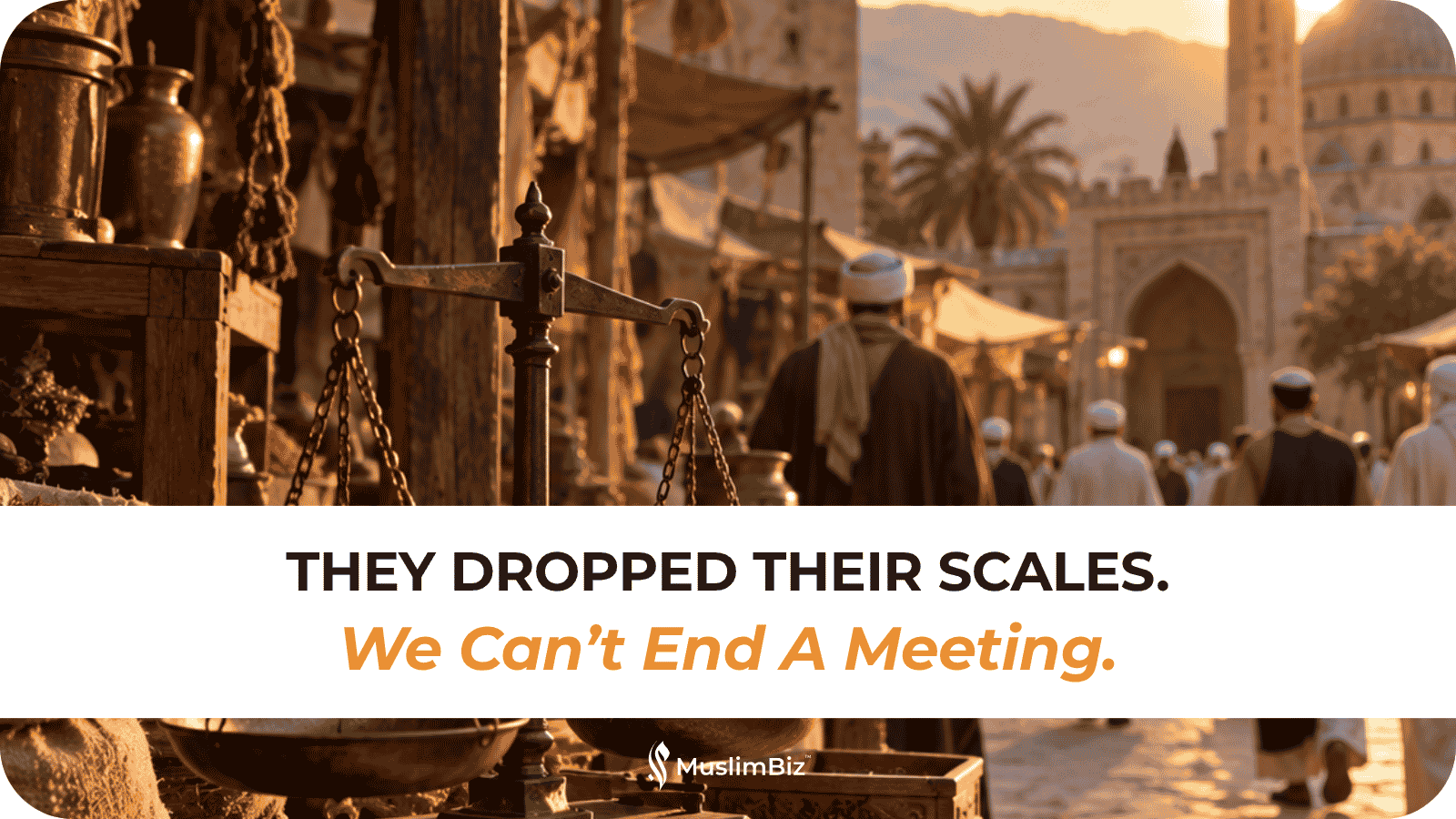
"They used to buy and sell, but when one of them heard the call while his scales were in his hand, he would put them down and turn to prayer."
⠀
This narration is mentioned in Tafsir Ibn Kathir's explanation of Surah An-Nur 24:37.
⠀
Consider what this means.
⠀
The merchant could have completed the transaction.
⠀
He could have finished weighing the merchandise.
⠀
He could have told himself that he would pray once the customer had left.
⠀
But he understood that the call to prayer represented something greater than the transaction taking place in front of him.
⠀
His business had a place in his life, but it did not occupy the place reserved for Allah سبحانه وتعالى.
⠀
This is the mindset Muslim founders should seek to restore within their companies.
Muslim Founder Brief
A daily briefing on Muslim ownership, responsibility, and disciplined building.
Building a Muslim Workplace Around Salah
⠀
A Muslim company's calendar should reflect its convictions.
⠀
It is not enough to tell employees that they are allowed to pray.
⠀
The company's systems should make it practical for them to fulfill that obligation.
⠀
This requires intentional leadership.
⠀
End meetings before Salah.
⠀
When scheduling internal meetings, consider prayer times before sending invitations.
⠀
Avoid creating situations where employees must choose between completing a meeting and praying on time.
⠀
Protect genuine prayer breaks.
⠀
Employees should have sufficient time to make wudu, perform Salah, and return to their responsibilities without unnecessary pressure.
⠀
Prayer should not be treated as a privilege that employees must repeatedly request.
⠀
Make managers responsible for respecting Salah.
⠀
A company's values mean very little if its managers routinely schedule calls during prayer times or pressure employees to delay their worship.
⠀
Leadership must demonstrate the standards it expects others to follow.
⠀
Build the workday around the masjid where possible.
⠀
For Muslim-owned businesses operating near a masjid, there may be opportunities to organize breaks around congregational prayer.
⠀
Not every business can stop operations simultaneously.
⠀
Hospitals, essential services, retail operations, and other workplaces may require staggered schedules to maintain their responsibilities.
⠀
But operational complexity should encourage better planning, not become an automatic excuse for neglecting Salah.
⠀
A Muslim company should make obedience to Allah easier for its employees, not harder.
⠀
These practices are part of building a workplace where Islamic principles shape everyday decisions rather than remaining statements on a company's website.
⠀
They also reflect a broader responsibility discussed in Islamic business ethics, where commercial activity is understood within a moral framework rather than treated as separate from religious obligations.
⠀
A Muslim Business Is Defined by What It Prioritizes
⠀
Muslim founders often spend considerable time discussing what makes a business halal.
⠀
We examine financing arrangements.
⠀
We consider whether products and services are permissible.
⠀
We avoid riba and prohibited transactions.
⠀
These are essential considerations.
⠀
But the responsibilities of a Muslim founder extend beyond the products being sold and the contracts being signed.
⠀
They also include the environment we create for the people who work within our organizations.
⠀
A business can sell halal products while developing a workplace culture that makes fulfilling Salah unnecessarily difficult.
⠀
A founder can speak about serving the Ummah while expecting employees to place meetings ahead of their religious obligations.
⠀
And a company can promote Islamic values publicly while failing to implement those same values internally.
⠀
This is why Muslim ownership alone does not guarantee that a company operates according to Islamic principles.
⠀
The true test often appears in ordinary decisions.
⠀
When a meeting runs into prayer time, what happens?
⠀
When an employee needs to leave for Salah, how does their manager respond?
⠀
When the workday is being planned, is prayer considered from the beginning or accommodated only when convenient?
⠀
These decisions reveal what an organization actually prioritizes.
⠀
For Muslim founders, this is also a matter of leadership and amanah.
⠀
We are responsible for the systems we establish, the expectations we communicate, and the workplace cultures we allow to develop.
⠀
A Muslim company is not defined only by who owns it.
⠀
It is also defined by what comes first when the meeting and Salah collide.
⠀
If we truly believe that our businesses exist to serve Allah سبحانه وتعالى, shouldn't our calendars reflect that belief?
Muslim Founder Academy
Everything you need to build your business the Muslim way - from idea to institution.