
3 minutes read
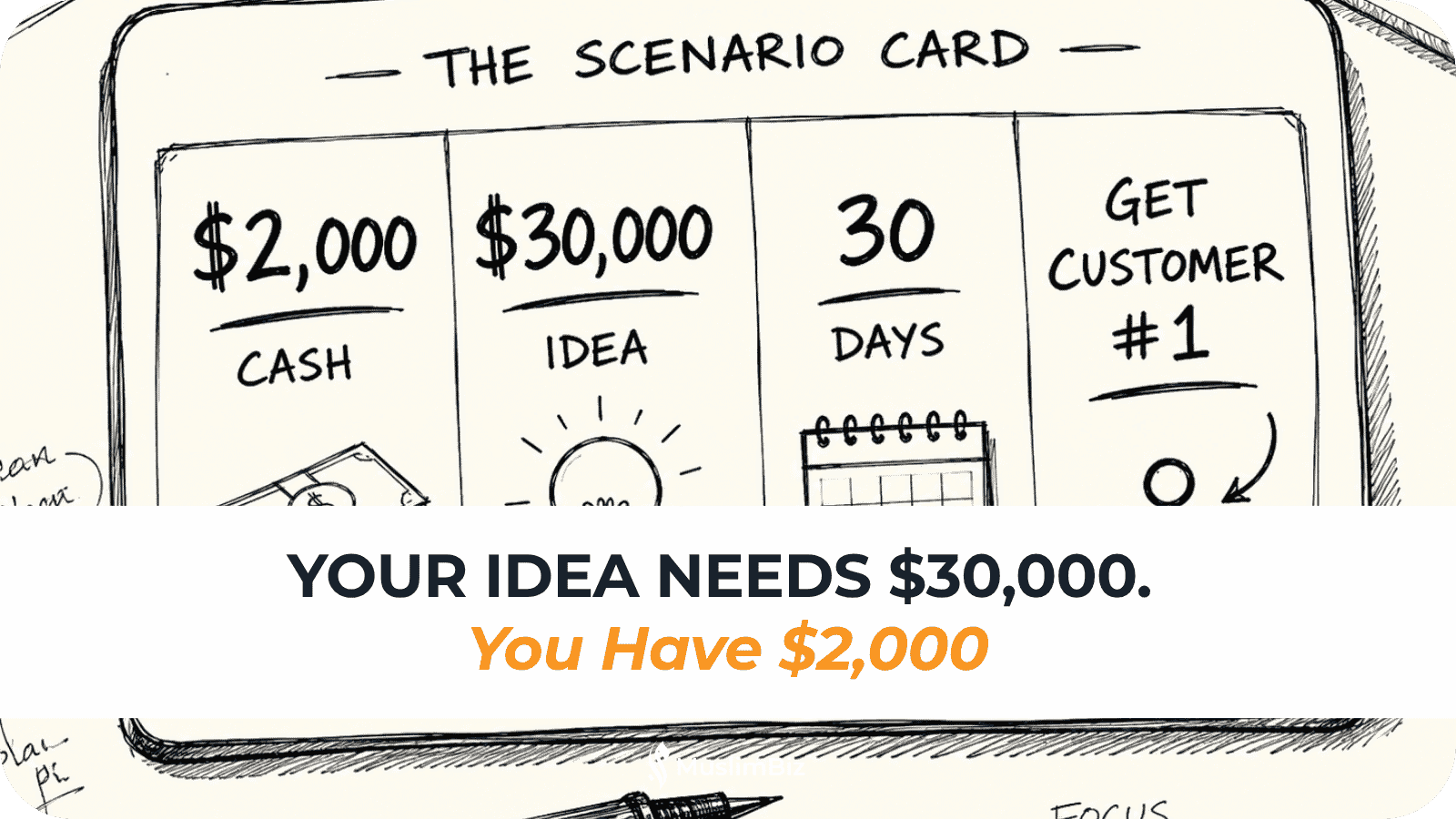
You have $2,000, a business idea that appears to require $30,000, and nobody is coming forward to fund you.
What do you do?
You could wait until you save another $28,000. You could start approaching investors. You could look for financing.
Or you could question the $30,000 altogether.
Muslim Founder Brief
A daily briefing on Muslim ownership, responsibility, and disciplined building.
The $30,000 Problem
One of the easiest mistakes for a new founder is assuming that the business must be built in its final form from day one.
You imagine the office, the employees, the professional branding, the sophisticated website, the technology, the equipment, the inventory, and all the systems required to operate at scale.
Then you calculate the cost.
$30,000.
The problem is that you have $2,000.
So the gap becomes the problem.
But perhaps the gap should not be the focus.
Perhaps the real question is:
What can I build with the $2,000 I already have?
Your First Objective Is Not to Build the Company
Imagine you have $2,000 and exactly 30 days.
Your objective is not to build the company you imagined.
Your objective is to get customer #1.
That changes everything.
You do not necessarily need an office.
You do not need employees.
You do not need expensive branding.
You do not need an Amazon-style website.
You do not need complicated systems.
You need to discover the smallest version of your product or service that someone is willing to pay for today.
That first customer gives you something more valuable than a theoretical business plan.
It gives you evidence.
Start With the Smallest Viable Version
Suppose you want to build software.
Your original plan might involve hiring developers, building a complete platform, designing an interface, setting up infrastructure, and spending months developing the product.
But what if you manually provide the service first?
You could use existing AI tools to help deliver the result. You could operate manually behind the scenes. You could learn what customers actually need before spending thousands of dollars automating the process.
The software can come later.
The customer does not necessarily care how sophisticated your internal system is.
They care about the result.
Now suppose you want to manufacture a physical product.
Your plan might involve ordering 1,000 units from an overseas manufacturer.
But before committing to that inventory, could you produce five or ten units locally?
Sell them.
Gather feedback.
Improve the product.
Then produce more.
Your first objective is not mass production.
It is proving that people will buy.
Or perhaps you want to open a physical location.
Instead of immediately signing an expensive lease, could you begin somewhere you already have access to?
Your home.
A shared space.
A temporary location.
A partner's facility.
The final business may eventually require its own location.
But the first customer might not care where you started.
Let Customer #1 Fund the Journey
The $30,000 business may be the destination, but it does not have to be the starting point.
Your first version can be simple, manual, and far from the polished business you eventually want to build. Start with the $2,000 you have, get customer #1, listen to what they need, and use that revenue and feedback to improve. Then get customers #2 through #10, reinvest the profits, and keep building.
Some businesses genuinely require significant upfront capital, but many founders look for funding before exhausting what they can build with the resources Allah سبحانه وتعالى has already provided them.
You may not have $30,000, a team, an office, or a finished product, but you may have the skills, time, knowledge, relationships, and resources to serve your first customer. Instead of asking, “Who will fund my idea?”, ask, “How can my first customer fund my journey?” Your $2,000 does not need to build the final company.
It needs to get you to the next step. Eventually, you may have what you did not have at the beginning: customers, revenue, data, experience, and proof of demand.
At that point, you are no longer asking someone to fund an idea. You are building a business.
Muslim Founder Academy
Everything you need to build your business the Muslim way - from idea to institution.